
"Act locally, think globally" – the recycling legacy that changed the Cotswolds
The idea of tossing cans, glass and newspapers into the general waste bin would feel completely alien today, but when Cotswold District Council launched one of its first recycling campaigns in 1990, that was exactly how most waste was dealt with.
More than three decades on, the impact of those early initiatives can still be seen. The Cotswold district now recycles around 57% of household waste, significantly outperforming the England average of around 44% and maintaining a reputation as one of the country's leading recycling authorities.
But perhaps the biggest change is not how much we recycle, but why. In 1990, recycling was largely about keeping waste out of landfill. Today, it plays an important role in tackling climate change, supporting green jobs and creating a more circular economy where resources stay in use for longer.
As part of our ongoing look back at moments that have shaped the district, we're revisiting the pioneering recycling initiatives that helped lay the foundations not only for the services residents use today, but also for the wider environmental ambitions that now underpin them.
Cotswold Scrap
One of the earliest campaigns began 36 years ago when the council partnered with Cotswold Scrap to encourage people to recycle aluminium cans. At the time, the council highlighted that recycling aluminium used just five per cent of the energy required to produce it from raw materials.
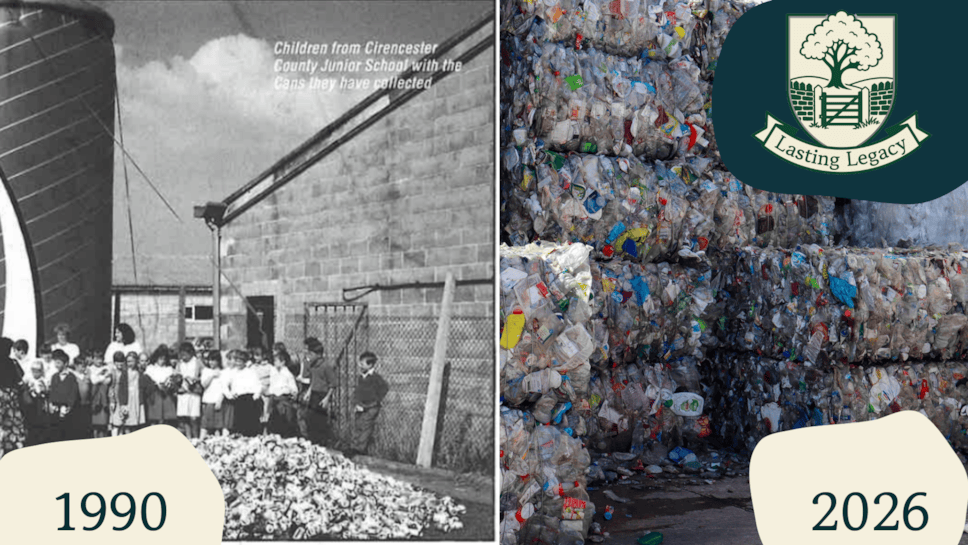
Archive photographs from the launch show local schoolchildren standing beside mountains of collected cans, accompanied by an improbably large inflatable drinks can. Residents may also remember visiting the Love Lane scrapyard, where cans were checked, crushed and weighed before participants received 50 pence per kilogram recycled.
In the early days, the focus was on reducing landfill and saving resources. Today, recycling is part of a much bigger picture involving climate action, resource efficiency and supporting a greener economy - Peta Johnson, Head of Waste
What now feels like a modest scheme was part of a much bigger cultural shift, introducing many people to the idea that household waste could be treated as a resource rather than simply thrown away.
The council took another major step forward in 1997 by extending kerbside recycling across the district. At the time, it was thought to be among the first rural authorities in the country to provide district-wide household recycling collections. Residents received recycling boxes for glass bottles and jars, newspapers, magazines and food and drink cans. Plastics, now a significant part of household recycling, were notably absent because the necessary technology and infrastructure had not yet developed.
Circular economy
But while the bins have changed, so too has the ambition behind them. In the 1990s, recycling was mainly about reducing landfill and saving resources. Today, it is part of a wider effort to create a circular economy, cut carbon emissions and support a greener, more sustainable future.
Modern recycling services create jobs, reduce the need for new raw materials and help keep valuable resources in use for longer. Household waste that cannot be recycled in Gloucestershire is now used to generate energy rather than being sent to landfill.

Peta Johnson, Head of Waste at Cotswold District Council, said: "Those early campaigns helped turn recycling from something unfamiliar into an everyday habit, and residents across the Cotswolds deserve a huge amount of credit for embracing that change.
"The ambitions have changed too. In the early days, the focus was on reducing landfill and saving resources. Today, recycling is part of a much bigger picture involving climate action, resource efficiency and supporting a greener economy.
"And we're continuing to build on that legacy, as we prepare for plans to introduce collections for plastic bags and wrapping so residents can recycle an even wider range of everyday items from home.
"What began with a few recycled cans has grown into something much bigger, helping to support our environment, our economy and our climate ambitions."