
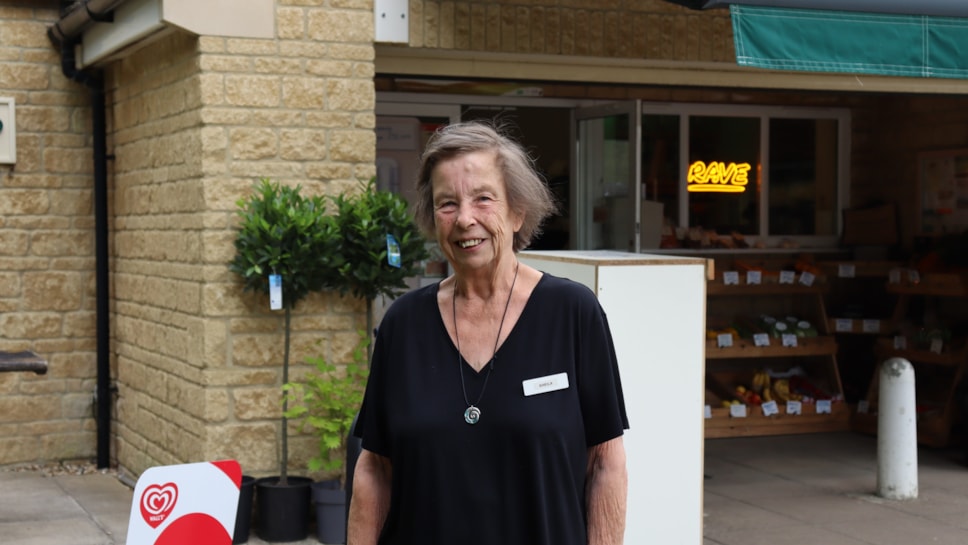
Down Ampney – a shop at the heart of the community
Important community hubs, like Down Ampney Village Shop have survived thanks to a legacy of Council-backed funding and the tireless work of local volunteers. Founder of the Down Ampney Shop Association, Sheila Bull shares its history.
The council has a longstanding history of supporting community projects and playing a role in their continued existence. Since launching in 2021, Crowdfund Cotswold has raised more than £1.2m for local projects and Cotswold District Council has pledged more than £300,000 to support 60 community initiatives across the district.
In the latest round of funding, Down Ampney Village Shop received £8,000 to improve the environmental sustainability of the village shop and café.
However, this is just the latest phase in a varied and at times, dramatic history.
The Down Ampney Village Shop Association was established by local resident, Sheila Bull to ensure that the community could preserve its independence benefit from the support of over 100 members.
The shop, café and post office continues to be well-loved and enjoyed by generations of residents and visitors. We spoke to Sheila at the time that the latest funding was announced, and she shared her some of its history and the challenges behind the bustling site it is today.
“When people talk about community spirit, I always think back to 1997.
“At the time, the owner of our village shop wanted to sell, but couldn't find a buyer who would keep it running as a shop. For our village, that was a frightening prospect. The parish council called a public meeting and it was absolutely packed. People were genuinely upset at the thought of losing such an important part of village life. A lot of residents remembered times when there hadn't been a shop in the village, and nobody wanted to return to that.
“I've lived here for more than 40 years and, somehow, I found myself on the steering group set up to work out what could be done. Very quickly, we realised that saving the Post Office had to be our priority.
“It's easy to forget how different life was then. Pensions and allowances were collected through the Post Office and many households only had one car. Often one person would leave the village for work, leaving others without transport during the day. We also had many older residents and, to be honest, bus services have always been a bit unreliable here. The Post Office wasn't simply convenient. For many people, it was essential.
“I volunteered to take on the Post Office temporarily. The shop closed at the end of August 1997, but just one day later we reopened the Post Office in the village hall. We operated from the bar because it was somewhere secure. Looking back, it's remarkable how quickly everyone pulled together to make it happen.
“While we worked out a longer-term solution, we started fundraising. The village only had around 500 people on the electoral roll, so raising significant sums of money wasn't going to be easy. Around the Post Office counter, I sold small essentials such as batteries and greeting cards, and we organised coffee mornings.
“Those coffee mornings became about much more than fundraising. Ours is a long, linear village and people from different ends of the community didn't always get the opportunity to see one another. Suddenly there was a place where neighbours could gather, catch up and share stories. It reinforced something we were already beginning to understand: what we were creating wasn't just a shop. It was a community hub.
“The next challenge was finding premises.”
“We knew we couldn't afford to build from scratch, so we looked at buying a second-hand portacabin. Even that seemed beyond our reach. At the time, one cost around £10,000, an enormous amount of money for a small village to find.
“Then I remembered seeing a collection of portacabins being used during construction work on the A419 near Cherry Tree Lane. I decided to write to our MP at the time, Mr Clifton-Brown, to see if he could help us find the right contact. To his credit, he did exactly that.
“I went to meet the site manager with one of our volunteers, Rob, a brilliant handyman. We were hoping they might sell us a cabin cheaply.
“Instead, they gave us one. I couldn't quite believe it.”
“Getting it to the village was the next challenge, but once again people stepped forward to help. A friend provided a low loader, a crane was made available and before long the portacabin arrived in the village. I still remember children from the playgroup lining up to watch the crane manoeuvre it into place. It was quite a spectacle.
“With the help of Rob and Denzel, a retired builder, the cabin was transformed into something we could be proud of. What started as a temporary solution ended up serving the village for more than a decade, from 1998 until 2011.
“Looking back now, what stays with me isn't the portacabin, the fundraising events or even the challenge of keeping the shop and Post Office open. It's what happened when the village was faced with losing something important.
“People didn't simply accept that it was gone. They rolled up their sleeves, shared their skills, gave their time and found solutions together. From volunteers and builders to local organisations and residents, everyone played a part.
“The shop became far more than somewhere to buy milk, batteries or a newspaper. It became a place where people met, caught up with neighbours, exchanged news and stayed connected. In a rural village, that sense of belonging matters enormously.
“More than 25 years on, the real legacy isn't the building that was created or even the services that were saved. It's the example that was set. When a community comes together with a shared purpose, remarkable things can happen.
“I hope future generations never take the shop for granted, because every person who walks through its doors today is benefiting from the determination and generosity of those who refused to let the heart of the village disappear.
“For me, that's the legacy. We didn't just save a shop or a Post Office. We preserved a place where people belong, and in doing so we strengthened our village community for generations to come.”
Cotswold community projects backed by Crowdfund pledges | Cotswold District Council News
Crowdfund Cotswold - Home - Spacehive
A Greener Future for Down Ampney's Shop & Cafe
Find out more about our Lasting Legacy project here.

