
From deluge to legacy: how one big rainfall helped reshape flood risk management
As part of our Lasting Legacy project, we're reflecting on key moments in the council's history. The flooding of 2007 was unprecedented challenge for many, including council staff and service providers. It led to changes that still have a positive impact today. Chris Roberts was at the leisure centre in Cirencester in her new role as a councillor for Cotswold District Council, when the phones started ringing.
“Something very abnormal was happening,” she recalls. “It was obvious that it was something big.”
That “something big” was an event that will live long in many memories – the July 2007 deluge that led to catastrophic flooding across the county, but also acted as the catalyst for a process that ultimately shaped the flood risk management system the Council has today.
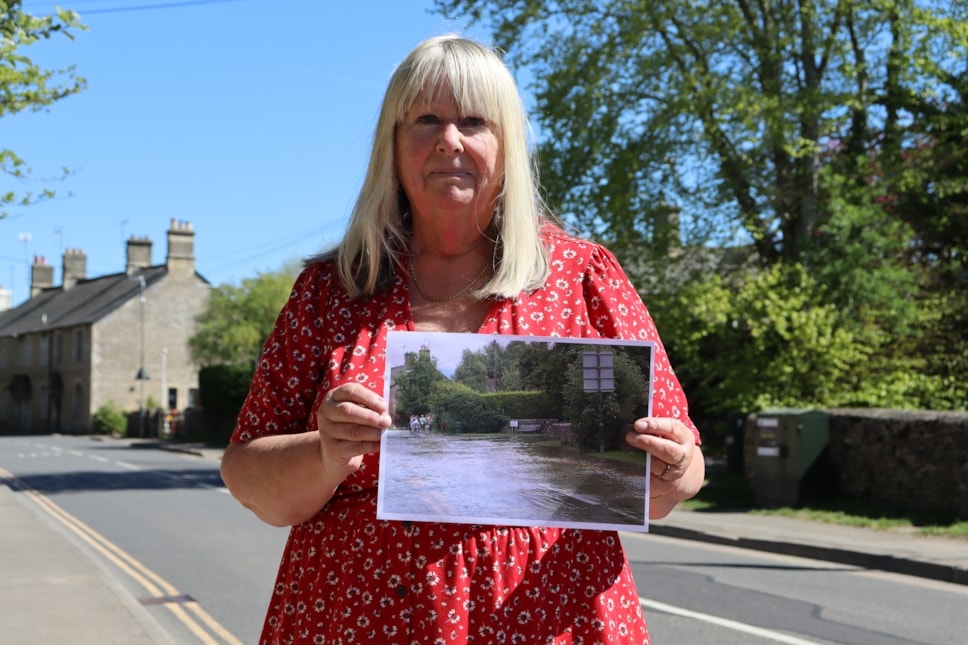
Back in the leisure centre, Chris – who today is a Fairford Town Councillor – was told that people were being evacuated from their homes because of flooding. She set off for what should have been a relatively short journey home to Fairford but which in the end took her two hours. Her day didn’t get any easier as she helped first her son and then a friend cope with what very quickly became a very scary situation.
Arriving at her friend’s house, mop and bucket in hand, Chris said she found “gallons and gallons” of water coming off the field and into her house. “The wheelie bin was floating down the road and my mop and bucket were useless,” recalled Chris.
In the months and years after 2007, the stories from Fairford, Cirencester and dozens of other communities made one thing clear: this could not be treated as a one‑off. What followed was a deliberate shift in how the Council approached flooding - away from reacting and towards understanding risk, reducing it, and helping communities feel safer for the future.
CDC flood risk officer Sam Carrier, explained that this change was as much about mindset as it was about infrastructure.
“The 2007 floods exposed just how complex flooding actually is,” he said. “It’s not one cause and one solution - it’s surface water, rivers, ditches, sewers, ground conditions, development patterns. You can’t manage that effectively unless you step back and take a long‑term, strategic view.”
That thinking shaped the work of the Flood Defence Engineering team, which later evolved into what is now the Flood Risk Management (FRM) function. Crucially, the expertise built up after 2007 was retained and expanded, ensuring continuity and learning from one incident to the next.
“A big part of our role has always been advice,” Sam said. “To residents, parish councils, developers, planning colleagues - helping people understand what their actual flood risk is, and what practical steps can make a real difference. That’s everything from property‑level resistance and resilience, right through to how new development manages water.”
Over time, the Council also began working more closely with communities themselves. Flood Wardens were introduced as trusted local contacts - people who knew where water flowed, which fields filled first, and which drains always struggled.
“That local intelligence is invaluable,” Sam explained. “Flooding is incredibly site‑specific. Wardens help us understand the detail you just can’t see from a map.”
Alongside this, the Council delivered a series of targeted, parish‑level flood alleviation schemes. These weren’t headline‑grabbing, mega-projects, but practical, proportionate interventions designed around local conditions, collectively reducing flood risk across large parts of the district and, perhaps most importantly, reducing repeat flooding for many homes.

Working with planning colleagues also became a central strand of the work, embedding sustainable drainage systems (SuDS) into new developments so that growth was supported by better water management, rather than adding to the problem.
All of this meant that, while the Flood Risk Management team has since been restructured, the function itself is no less important. The legacy of 2007 lives on in a service that continues to protect people, places and infrastructure across the Cotswolds.
Fairford provides one of the clearest examples of what that shift achieved on the ground.
In the aftermath of the floods, the town came together to create a full resilience programme. With £160,000 in Environment Agency funding and a £10,000 community resilience grant from Cotswold District Council, Fairford invested in measures designed to reduce flooding risk and improve preparedness when heavy rain does fall.
“It was about putting things in place to keep us safe for the future,” said Chris.
The change wasn’t just physical - it was emotional too.
“Back then, as soon as we had one spot of rain people would panic,” she said. “Now it’s not that we’ve forgotten what it was like - it’s just that we know it’s a lot safer.”
Fairford’s approach didn’t go unnoticed. The Council singled the town out as a case study, recognising it as one of the first to put a comprehensive emergency action plan in place.
“Other towns took that on because they could see the difference it made,” Chris said. “How people felt about their town, how safe they felt - that the water and the flooding and the rain weren’t something to be frightened of anymore.”
Nearly two decades on, the events of 2007 are still remembered. But so is what came after. From that day in the leisure centre when the phones wouldn’t stop ringing, to a district‑wide system built on experience, expertise and community partnership, something lasting really did come from something big.