
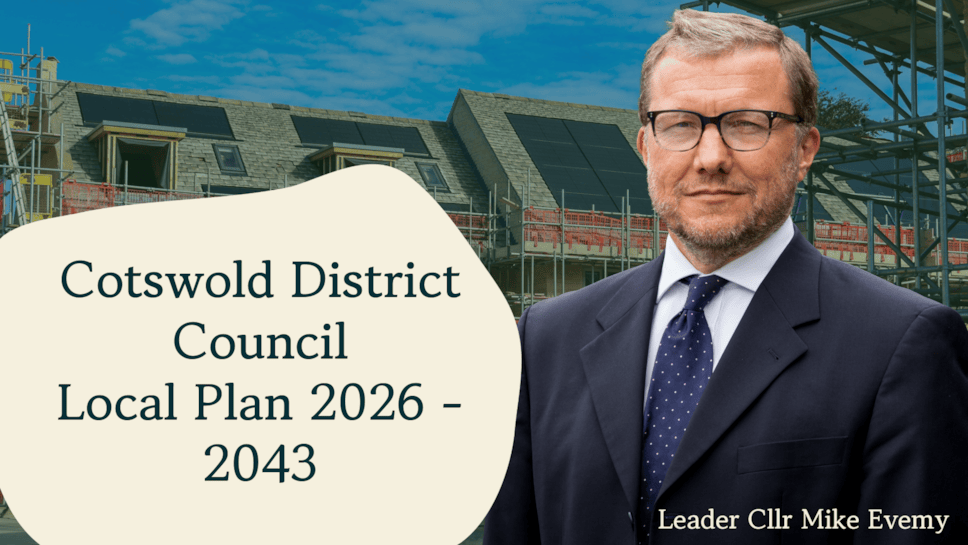
New Local Plan puts infrastructure, affordable homes and landscape protection at the heart of growth
Cotswold District Council has today published the complete draft of its Local Plan, designed with infrastructure at its heart, to deliver more affordable and smaller homes, protect the Cotswolds National Landscape, and give communities far greater certainty against speculative, piecemeal development.
The plan, which will be considered by councillors over the next few weeks, sets out a long-term vision for healthy, sustainable communities, with growth carefully planned to create lasting benefits for current and future generations.
Subject to approval by councillors, residents will get to have their say during a six-week consultation from 24 August to 5 October 2026.
The district’s Local Plan, which is underpinned by more than 40 studies and assessments, sets out where around 18,900 new homes could be delivered in the district between 2026 and 2043.
The plan is the locally shaped response. It provides a framework based on local evidence to manage growth in a coordinated way, ensuring homes, jobs, transport, community facilities and environmental priorities are considered together. It plans development in the most sustainable locations, protects valued landscapes, and sets ambitious standards for communities.
At the same time, it carefully balances the need for new development with the protection of the landscapes, heritage and distinctive character of the Cotswolds.
Much of that development is proposed on 10 strategic sites, allowing homes, employment, transport and community infrastructure to be planned comprehensively and sustainably.
Work on the plan follows significant changes by Government to the way housing need is calculated, as part of a drive to build 1.5million homes across the UK between 2024 and 2029. This new method was introduced almost two years ago and more than doubled the district’s housing target, - meaning the Council can no longer demonstrate that it has a five-year supply of land for housing.
This has left communities more vulnerable to speculative, piecemeal development.
Cotswold District Council Leader Cllr Mike Evemy said the plan was “absolutely vital” to stop speculative development and start building not just houses but sustainable, healthy communities.
“The Council has been clear about the scale of the challenge created by the huge increase in nationally calculated housing need,” he said.
“But failing to progress a new Local Plan does not remove the pressure for development. Instead, it simply leaves our communities more exposed to speculative proposals and the Council with the risk of costly appeals. It would leave us with less influence over where growth takes place, the quality of developments, and the infrastructure delivered alongside them.
“These are difficult choices, but avoiding them would not protect the Cotswolds.
“This is a plan we can stand behind. It is rigorous, it is considered, and it offers the best route to take control of our District’s future.
“It will deliver the affordable homes, jobs and services our communities need. It will protect the landscapes, heritage and character that make the Cotswolds such a special place to live and visit. And it will ensure we play a bigger role in tackling the climate crisis, while lowering energy bills through efficient new homes.”
What the plan would deliver
The proposed Local Plan includes:
- Around 95% of proposed development outside the Cotswolds National Landscape, with development within it restricted to smaller, less sensitive sites
- Around 90% of proposed development on strategic allocations, maximising opportunities to secure significant, coordinated infrastructure investment
- Policies supporting the delivery of around 5,600 affordable homes over the plan period, including a 40% affordable-housing target on qualifying sites
- A greater proportion of smaller two and three-bedroom homes that better meet the needs of local people
- New and expanded education provision, including proposed new secondary schools at Moreton-in-Marsh and south of Preston, alongside transport improvements, health and community facilities, local centres, public open space and green infrastructure
- New employment opportunities and land to support local businesses and economic growth, and
- Ambitious climate policies covering net-zero-carbon new buildings, renewable energy, the decarbonisation of existing buildings and low-carbon heat networks.
Strategic sites
The plan concentrates growth in the district’s most sustainable locations, where services, jobs and transport links allow infrastructure and community facilities to be planned comprehensively. Ten proposed strategic allocations would deliver 11,302 homes within the plan period at
- Moreton-in-Marsh: 2,217 homes
- Down Ampney: 1,658 homes
- Preston: 1,368 homes
- Mickleton: 1,238 homes
- Fairford: 1,141 homes
- New settlement south of Driffield: 1,090 homes (with the potential for more development in the longer term beyond 2043)
- Kemble: 1,020 homes
- Cirencester: 613 east of Kingshill Lane (two allocations)
- Cirencester: 585 homes south of The Steadings (with the potential for more development in the longer term beyond 2043)
- Siddington: 372 homes
Backed by evidence
The plan is supported by a comprehensive suite of technical evidence and expert advice, covering matters including housing need, site suitability, transport, flood risk, landscape, heritage, ecology, viability and infrastructure. Sustainability and climate change are embedded throughout, ensuring future growth is planned in a way that supports both communities and the environment and is ‘green to the core’.
The proposed plan also responds to concerns raised during the Regulation 18 consultation in autumn 2025, including the protection of landscapes and heritage, support for the local economy, the need for affordable and smaller homes, health and community facilities, transport and infrastructure.
Next steps
The proposed plan will be considered by the Overview and Scrutiny Committee on 3 August, Cabinet on 6 August and Full Council on 12 August 2026. Subject to approval, a six-week Regulation 19 consultation will run from 24 August to 5 October.
The Council will consider the representations received and may recommend additional modifications for the inspector to consider. The plan and all consultation responses are expected to be submitted to the Secretary of State in December 2026 for independent examination by a Planning Inspector during 2027. Adoption of the Plan is currently expected around March 2028.
Submitting the plan before the end of December 2026 is important because plans not submitted by that deadline will need to follow the Government’s new plan-making system, potentially delaying the adoption of an up-to-date plan by several years.
Contact Information
Cotswold District Council Communications Team
Notes to editors
Notes to editors:
Read the proposed Local Plan: Draft Cotswold District Local Plan.pdf
You can view all additional documents at the bottom of this page: Cotswold District Council - Agenda for Overview and Scrutiny Committee on Monday, 3rd August, 2026, 4.00 pm
Regulation 19 consultation: The consultation will open on 24 August and run for six weeks, closing on 5 October 2026. Representations made during this period will be considered as part of the independent examination into whether the plan is legally compliant and sound.
Public exhibitions will take place at:
Fairford Community Centre, Fairford: Tuesday 25 August, 1pm–7.30pm
Cirencester Baptist Church, Cirencester: Friday 28 August, 1pm–7.30pm
Redesdale Hall, Moreton-in-Marsh: Tuesday 15 September, 1pm–7.30pm
Chipping Campden Town Hall, Chipping Campden: Tuesday 22 September, 1pm–7.30pm
These exhibitions offer opportunities for residents to ask questions and share their thoughts during the consultation period.