
Sealife Mosaic fragment from Cirencester finds it way back to the Corinium Museum
A fragment from a long-lost 2nd century Roman mosaic depicting a sea creature has found
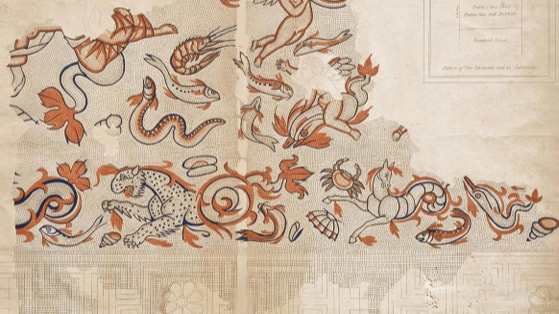
its way back to the Corinium Museum. The mosaic was originally unearthed on Dyer Street
in 1783 and recorded through an intricate drawing by the antiquarians Samuel Lysons and
Richard Smirke.
The mosaic depicted a procession of sea creatures, both real and mythological. Amongst the
real creatures were fish, an eel, bivalves, a crab and a shrimp alongside the mythological
figures including swimming cupids, a sea-horse and a sea-leopard. The Lysons/Smirke sketch
suggested a central design that may have featured Neptune in his chariot, with a Nereid
riding a sea creature.
The mosaic was reburied in the 19th century but partly revealed once again during the
1980s, under the foundations of Gloucester House on Dyer Street. By this time, the mosaic
had suffered damage due to various building constructions throughout time but one corner
fragment of the mosaic was lifted and saved by the then Assistant Curator of the Corinium
Museum, Stephen Clews and conservator, Marilee Parrott. The fragment was subsequently
conserved by Nerina de Silva as part of an BSc thesis after which it resided in the private
care of the Lamplough family, then owners of Gloucester House until today…
It’s 2026 and an e-mail arrives from the son of the owner, Piers Lamplough, asking if the
Corinium Museum staff would like to see the lifted sea life fragment. It arrived at the
museum for the first time in 45 years to the delight of the museum team. Piers offered to
leave it at the museum on loan for 5-years with a view to this being put on temporary
display for the public to enjoy.
Emma Stuart, Director of Corinium Museum, said: “When the mosaic arrived at the
museum, we all gathered round in anticipation. The museum already displays two mosaics –
the Seasons and Hunting Dogs – presumed to be from the same Roman town house that
also commissioned the sea life mosaic floor. We all thought the mosaic lost forever so to
have a fragment find its way back to us after all this time is incredibly exciting. It’s really
important too as it provides tangible evidence to support the early illustrations and 1980s
photographs of yet another incredible mosaic from Roman Corinium. You get a wonderful
impression of the colours and materials used when you see it up close.”
Piers Lamplough, son of the owner of the mosaic fragment who deposited it at the museum
said:
“"We never truly own history. We simply become its custodians for a time, preserving it
until it finds its way to the next generation. This fragment has travelled an incredible path
through nearly two thousand years. It has quietly connected generations of people, from
those who created it, to those who rediscovered and conserved it, to those now helping
preserve it for the future. Looking back, the meetings, collaborations and unexpected
connections that have emerged along the way seem to have become part of its story. Living
in Sri Lanka, in the same place as Nerina de Silva, the person who first helped conserve the
fragment, was one of those moments that felt far beyond chance - serendipitous. To me and
my family, this fragment has never simply been an archaeological object, it is a reminder
that history has a way of bringing people together celebrating those from the past and
helping to write the next chapter in the story.”
Dr Pat Witts from the Association for the Study and Preservation of Roman Mosaics
(ASPROM) said:
"This 'lost' mosaic has been described as one of the best drawn and most classical in style of
all the Romano-British mosaics, so it is thrilling that part survives and has returned to the
museum on loan. On a recent tour of the museum's superb collection of mosaics, it was a
delightful bonus for members of ASPROM to see this fragment and to learn how it had been
saved."
The mosaic will be on display for the public to enjoy at the Corinium Museum by the end of
the year.
Contact Information
Cotswold District Council Communications Team
Notes to editors
About the Corinium Museum
The Corinium Museum is located at the heart of Cirencester, the ‘Capital of the Cotswolds’.
The principal collection consists of the highly significant finds from the Roman town of
Corinium. However, the museum today is much more than that, taking you on a journey
through time and charting the development of the Cotswolds from its prehistoric landscape
to the modern-day.
Freedom Leisure runs the Corinium Museum facility on behalf of Cotswold District Council.
About Freedom Leisure
Freedom Leisure is one of the largest charitable and not-for-profit leisure trusts in the UK
managing over 100 leisure and cultural facilities on behalf of partners across England and
Wales. We are proud to be delivering high quality, value for money locally-focused leisure
services that are sustainable and accessible to all and we are committed to their ongoing
development. As a not-for-profit organisation all surpluses are reinvested in support of the
objectives we share with our partners.
Improving lives through leisure
• Enabling communities to be more active more often, making the most of their leisure
time
• To be a fun and rewarding place for our colleagues to work
• To support our partners with the provision of great community facilities